(1).png)
 1 month ago
13
1 month ago
13
As 2025 drew to a close, a group of people from Yakutsk, the capital of Russia’s republic of Sakha (Yakutia), braved temperatures of minus 40 degrees Celsius to journey to the local flagship newspaper’s offices.
On Yakutsk Vecherniy’s doorsteps, they recorded a 12-second video that would quickly take the Sakha internet by storm.
“We came here, to Yakutsk Vecherniy’s office, on an important matter: to clarify,” a man says to the camera as he reaches into his jacket pocket to pull out a lilac-colored necktie.
“It is the end of the year, guys,” the man says, vigorously shaking the tie in his hand.
The stunt referenced a 2019 bet that Sakha’s head Aysen Nikolaev had made with Yakutsk Vecherniy’s chief editor in which he vowed to eat his tie if his government failed to build a bridge over the Lena River, which separates Yakutsk from the rest of Russia.
 A Yakutsk resident holds up a necktie in reference to Sakha head Aysen Nikolaev's vow to build a bridge over the Lena River.
yakutiam / Telegram
A Yakutsk resident holds up a necktie in reference to Sakha head Aysen Nikolaev's vow to build a bridge over the Lena River.
yakutiam / Telegram
Over six years later, the bridge still hasn’t been built.
The lack of a bridge linking the two banks of the world’s 11th-longest river leaves Yakutsk, a city of over 350,000 people, cut off from the rest of Russia for up to half the year — while thousands more are deprived of essential services available only in the capital of the resource-rich region.
Each year, this leaves hundreds of people with no choice but to risk crossing the river on unstable ice — potentially at the cost of their lives.
On thin ice
Yakutsk is the coldest major city on Earth. With January temperatures averaging minus 42 C, its extreme winter temperatures make it a popular spot for Russian and foreign endurance athletes and bloggers, whose content on surviving the Yakutsk winter racks up millions of views.
But for the people who live there, these harsh winters provide a rare overland link to the rest of the country. To the west of the city, frozen swampland allows the Vilyuy Highway to extend to Yakutsk, while to the east the Lena River freezes solid enough to be crossed by car or on foot.
That connection disappears as temperatures rise in spring, effectively turning the capital into an island cut off from the rest of Russia by the mighty Lena.
While ferries operate across the Lena in summer, they aren’t enough to accommodate the flow of essential goods, fuel and passengers into Yakutsk.
“The river fleet, like most enterprises in the republic, operates at a loss, so the ferries haven’t been upscaled for years and their number hasn’t increased,” explained activist Sargylana Kondakova, who lived in Yakutsk for two decades before moving abroad.
“Crossing the Lena is always accompanied by stress and uncertainty — it’s just part of everyday reality. If I had the option not to go, not to cross the river, I wouldn’t,” Kondakova added.
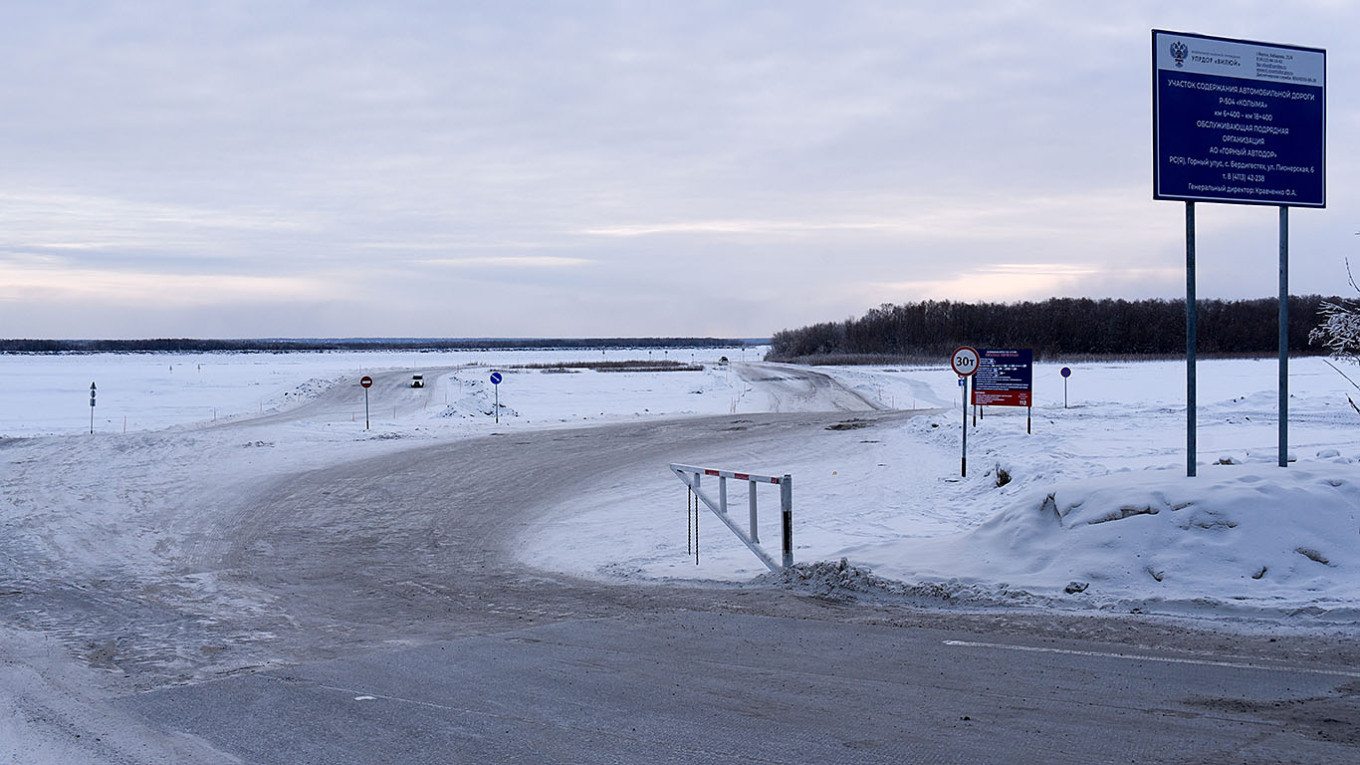 The winter ice road across the Lena River linking Yakutsk to Nizhny Bestyakh.
vl.rosavtodor.gov.ru
The winter ice road across the Lena River linking Yakutsk to Nizhny Bestyakh.
vl.rosavtodor.gov.ru
For residents of what Yakutians call the across-the-river uluses (districts), the ability to travel to the capital can be a matter of life and death. Most essential medical services, including MRI and CT scans, are available almost exclusively in Yakutsk hospitals.
“Hours-long waits for the ferry during the navigation season are something else,” a woman from an ulus on the right bank of the Lena told The Moscow Times.
“Only those who had to hold their place in that long line of cars can truly understand what it is like when vehicles with newborn infants, elderly passengers recovering from surgeries and exhausted, frustrated drivers bake in the summer heat for hours,” she added, speaking on condition of anonymity.
Official crossings of the Lena close during the shoulder seasons, leaving privately operated hovercrafts or icebreaker-assisted ferries as the only means of transportation between the two shores.
“Two times a year, we are left without fresh fruits or vegetables because shipments can’t come into the capital. Two times a year, we are left with no choice but to pay enormous amounts of money to monopolies operating the crossings,” a female resident of Yakutsk told The Moscow Times.
The woman said her job frequently requires her to travel from Yakutsk to suburban settlements across the river at a moment’s notice.
Each spring and fall, she pays anywhere from 5,000 rubles ($65) to 10,000 rubles ($130) to cross the river one way — an exorbitant amount for residents of Yakutsk, where the average monthly salary is 60,000 rubles ($780).
Those who cannot afford this option risk their lives crossing the river on foot or by car over thin ice.
“In my student years in Yakutsk, many of my friends from villages on the other side of the river crossed it on foot because they had no money,” the woman from a right bank ulus recalled.
“I myself once had to cross a river in Sakha, though not the Lena, over thin ice. I will never forget the black water beneath the crunching ice under my feet,” she said.
Reports of cars sinking and people dying after crashing through the ice appear in local media every year. Locals say that this “will continue until either a bridge is built or people become wealthy enough to stop compromising safety.”
The elusive bridge
Russian officials first floated the idea of building a bridge over the Lena River in the late 1980s, but the Soviet collapse thwarted these plans.
The idea was revisited in 2012 by Sakha’s then-President Yegor Borisov, who promised to complete the Lena Bridge by 2016.
But the project was shelved again after Russia annexed Crimea in 2014, with federal authorities allegedly redirecting funds toward the construction of the Crimean Bridge.
When Borisov’s successor Nikolaev made his infamous bet in 2019, the total cost of construction was estimated at 65 billion rubles ($855 million).
By the time the first components of the bridge support structure were installed in 2024, the cost had ballooned to 130 billion rubles ($1.7 billion).
“The Lena Bridge is a complex structure from a technical standpoint. The temperature range alone is extreme: it can reach 40 C in summer and drop to minus 60 C in winter,” said Viliua Choinova, Sakha activist and environmental engineer.
“Ordinary engineering structures are usually designed for the most extreme parameters — the lowest and highest loads, pressure, humidity and so on. In our case, we have all of those extremes at once,” Choinova said.
She likened the Lena Bridge project to the Brooklyn Bridge, another vital piece of infrastructure that had been built with groundbreaking technology.
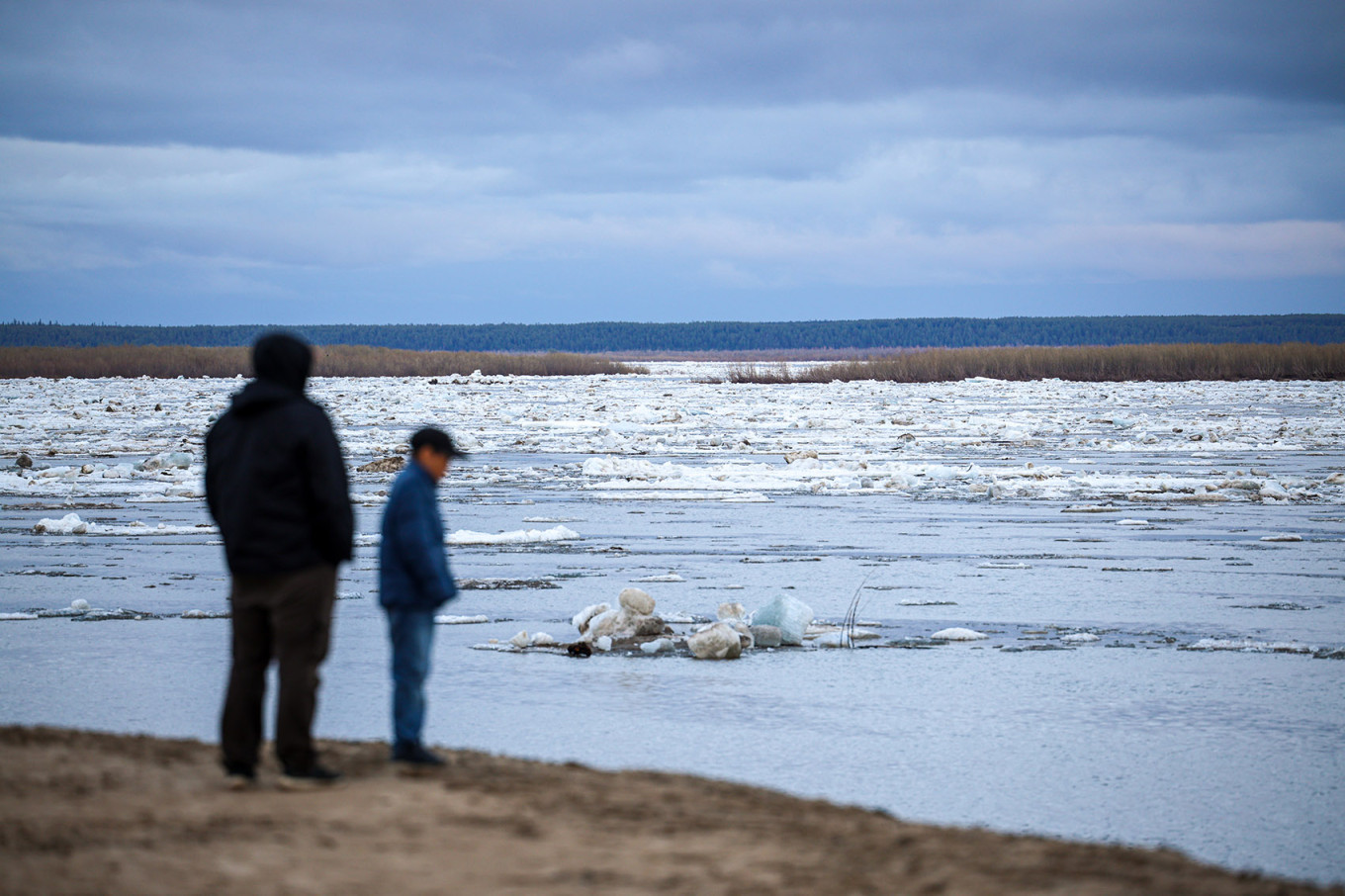 People look at floating ice on the Lena River.
Vadim Skryabin / TASS
People look at floating ice on the Lena River.
Vadim Skryabin / TASS
Sakha authorities have cited various reasons for the construction delay over the years, including the 2012 financial crisis, the Covid-19 pandemic and even the project’s economic infeasibility due to the relatively small population of the vast, resource-rich region.
“We’re constantly reminded that our population is less than a million,” activist Choinova said. “But how are we supposed to attract people to the region when we have no bridges, no roads, no basic infrastructure?”
The republic of Sakha is one of the world’s largest diamond producers and a key supplier of antimony, gold, silver and other precious metals to domestic and world markets.
Yet taxation of extractive industries in Russia overwhelmingly benefits the federal government in Moscow, meaning Sakha’s government lacks the money to invest in grand infrastructure projects.
Last year, Sakha’s government said it would be able to contribute only 27.3 billion rubles ($360,000) for the project, down from an earlier estimate of 43.3 billion ($560,000), signaling the need for additional financing from private investors or the federal government.
The bridge’s builder, VIS Group, which is linked to billionaire and close Putin ally Arkady Rotenberg, was expected to contribute 82.5 billion rubles ($1.1 billion), but media reports suggest it is also struggling to finance the project.
“If the project continues over the next two years, it should be funded from the federal budget, but we all understand where federal money is going today,” said activist Kondakova, referring to Russia’s immense spending on the war in Ukraine.
“As long as the war is going on, I don’t think it’s realistic to say that this megaproject will be completed. People don’t even care about this bridge anymore. Right now, they’re worried about finding food for the table and money to send their children to school,” Kondakova said.
People still living in the republic echoed this sentiment.
“Our Il Darkhan [head of the republic] is trying so hard to please the federal center. He has sent so many young men to the special military operation and given away so many of our resources, yet he still cannot build a single bridge for us,” the woman from Yakutsk said.
“I think most people stopped caring about the fate of the project because most do not believe that it will ever be realized in their lifetime,” she added.
A Message from The Moscow Times:
Dear readers,
We are facing unprecedented challenges. Russia's Prosecutor General's Office has designated The Moscow Times as an "undesirable" organization, criminalizing our work and putting our staff at risk of prosecution. This follows our earlier unjust labeling as a "foreign agent."
These actions are direct attempts to silence independent journalism in Russia. The authorities claim our work "discredits the decisions of the Russian leadership." We see things differently: we strive to provide accurate, unbiased reporting on Russia.
We, the journalists of The Moscow Times, refuse to be silenced. But to continue our work, we need your help.
Your support, no matter how small, makes a world of difference. If you can, please support us monthly starting from just $2. It's quick to set up, and every contribution makes a significant impact.
By supporting The Moscow Times, you're defending open, independent journalism in the face of repression. Thank you for standing with us.
Continue

Not ready to support today?
Remind me later.